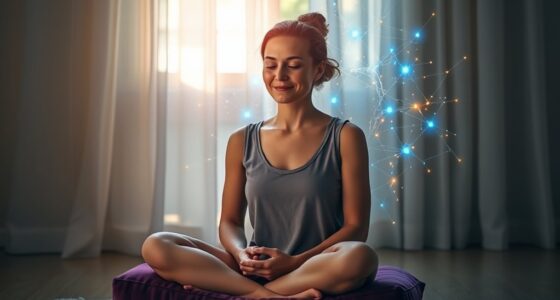
In your busy day, quick micro-meditations can help you stay calm and focused. Practice mindful breathing by taking a deep breath, holding it briefly, then slowly exhaling, paying attention to your body’s sensations. You can also try visualizing a peaceful place in a moment of stress. These simple, portable techniques fit into any routine and only take a minute or two. Keep exploring to discover more ways to incorporate micro-meditations into your daily life.
Key Takeaways
- Incorporate brief practices like mindful breathing or visualization into daily routines, such as during commutes or breaks.
- Use simple techniques that require no special equipment or quiet spaces for effective micro-meditation.
- Practice consistently, even for just one or two minutes daily, to build lasting stress relief habits.
- Integrate micro-meditations at different times of the day to maintain mental clarity and calmness.
- Enhance relaxation by pairing micro-meditations with essential oils or calming environments whenever possible.

In today’s fast-paced world, finding time for traditional meditation can seem almost impossible. Between work deadlines, family commitments, and social obligations, carving out even 10 minutes can feel like a luxury. That’s where daily micro-meditations come in—they’re short, effective practices you can do anytime, anywhere, to help you regain focus and calm. These quick exercises fit seamlessly into busy schedules and don’t require special equipment or a quiet room. Instead, they rely on simple techniques like mindful breathing and quick visualization to reset your mind and body in a matter of moments.
Quick, effective micro-meditations fit into busy lives, helping you find calm anytime, anywhere.
You can start by focusing on mindful breathing. Take a deep breath in through your nose, feeling the air fill your lungs. Hold it for a second, then slowly exhale through your mouth. Concentrate on the sensation of the breath moving in and out, noticing how your chest rises and falls. Keep your attention on your breath for a few cycles—just a minute or two—and you’ll notice your thoughts settling. This practice helps anchor you to the present moment, reducing stress and increasing mental clarity. It’s especially useful during hectic days when your mind feels overwhelmed or scattered.
Quick visualization is another powerful micro-meditation technique that you can incorporate into your daily routine. Close your eyes if possible, and picture a peaceful place—a beach, a forest, or a quiet meadow. Visualize yourself there, paying attention to the details: the sound of waves, the scent of pine, or the gentle breeze on your skin. Imagine yourself feeling completely relaxed and at ease in this space. Even just a few moments of this mental escape can provide significant relief from daily stress and foster a sense of calm. You don’t need to be an artist or a visualization expert—simply creating a mental image that feels soothing is enough. This technique can be particularly helpful when you need a quick mental reset during a busy workday or before an important meeting.
Both mindful breathing and quick visualization are adaptable practices that you can do in the elevator, at your desk, or while waiting in line. They don’t demand much time but offer substantial benefits—clarity, calmness, and a renewed sense of presence. An understanding of essential oils can further enhance these moments by providing soothing aromas that promote relaxation and focus. The key is consistency; even a minute or two each day can help you build a habit that makes stress management more accessible. With practice, these micro-meditations become a natural part of your routine, empowering you to stay centered no matter how hectic life gets.
portable meditation cushion
As an affiliate, we earn on qualifying purchases.
As an affiliate, we earn on qualifying purchases.
Frequently Asked Questions
Can Micro-Meditations Replace Traditional Meditation Practices?
Micro-meditations can’t fully replace traditional meditation practices, but they do offer a practical alternative for busy schedules. While meditation comparison shows that longer sessions may deepen mindfulness, micro-meditations provide quick, effective moments of mental clarity. Their practice effectiveness lies in consistency; even brief pauses can reduce stress and improve focus. So, if time is limited, micro-meditations are a valuable tool to maintain your meditation routine.
How Long Does Each Micro-Meditation Typically Last?
Each micro-meditation typically lasts about 1 to 5 minutes, fitting easily into your busy schedule. According to duration guidelines, these short meditation lengths make it simple to stay consistent without feeling overwhelmed. You can choose the length based on your available time and focus, making it a flexible way to incorporate mindfulness into your day. Even brief sessions can help you feel more centered and refreshed.
Are There Specific Times of Day Best for Micro-Meditations?
Sure, because everyone knows the perfect micro-meditation timing is right before your alarm blares or right after you hit snooze. In reality, timing considerations vary—try fitting them into your daily routines, like morning coffee or lunch breaks. You’ll find that brief pauses in your day, no matter the hour, boost focus and calm. So, experiment with different times and discover when your mind is most receptive to a quick mental reset.
Can Micro-Meditations Help Reduce Stress Effectively?
Yes, micro-meditations can effectively reduce stress and improve mental clarity. When you take just a few moments for deep breathing or mindfulness, you activate your relaxation response, helping manage stress better. These short practices fit easily into your busy schedule, making consistent stress management possible. Over time, you’ll notice clearer thinking, calmer emotions, and a more balanced outlook, even during hectic days.
Do I Need Any Special Equipment or Space for Micro-Meditations?
You don’t need any special equipment for micro-meditations. A quiet environment is ideal, but it doesn’t have to be perfect. Find a spot where you feel comfortable and free from distractions, even if it’s just a corner of your room or a brief moment during a break. Minimal equipment, like a chair or cushion, can help, but the main focus is your presence and breath.
essential oils for relaxation
As an affiliate, we earn on qualifying purchases.
As an affiliate, we earn on qualifying purchases.
Conclusion
So, next time you’re rushing through your day, remember that even a tiny pause can make a difference. Ironically, it’s those brief moments you think are pointless that might just help you stay sane amid chaos. So, take a breath, embrace the small, and give micro-meditations a shot. Who knew that a few seconds of silence could be your secret weapon in a busy world? Sometimes, less truly is more—especially when it’s all you’ve got.

Free Guided Meditation and Relaxation
Fast Sleep I and II
As an affiliate, we earn on qualifying purchases.
As an affiliate, we earn on qualifying purchases.
mindfulness breathing timer
As an affiliate, we earn on qualifying purchases.
As an affiliate, we earn on qualifying purchases.