
Ocean acidification happens when excess CO2 from human activities dissolves into our oceans, lowering water pH and harming marine life. This process weakens calcium carbonate structures in shells, coral reefs, and other organisms, leading to coral bleaching and declining shellfish populations. These changes threaten entire ecosystems and fisheries, impacting biodiversity and human livelihoods. If you want to understand how this silent threat connects to climate change and what can be done, keep exploring more.
Key Takeaways
- Ocean acidification results from increased CO2 absorption, lowering water pH and disrupting marine chemistry.
- It weakens calcium carbonate structures in marine organisms like corals and shellfish, threatening their survival.
- Coral reefs bleach and degrade, losing biodiversity and providing less habitat for marine species.
- Declining shellfish populations impact fisheries, economies, and food security for coastal communities.
- Addressing carbon emissions is vital to mitigate ocean acidification and protect marine ecosystems.

Ocean acidification occurs when the Earth’s oceans absorb excess carbon dioxide from the atmosphere, leading to a decrease in the water’s pH levels. As CO2 levels rise due to human activities, like burning fossil fuels and deforestation, your oceans become more acidic. This shift in chemistry has serious consequences for marine life, especially for organisms with calcium carbonate shells and skeletons. You might not see it happening immediately, but the impact ripples through entire ecosystems, threatening biodiversity and food security.
Ocean acidification from rising CO2 threatens marine life, ecosystems, and global food security.
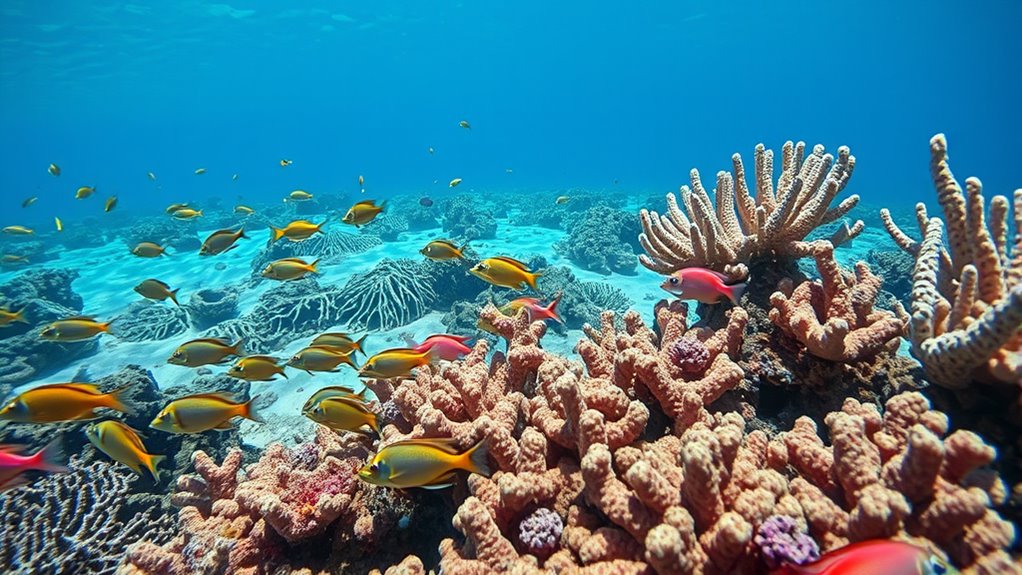
One of the most visible signs of ocean acidification’s effect is coral bleaching. Corals rely on a delicate balance of calcium carbonate to build their vibrant structures. When the water becomes more acidic, it hampers their ability to produce and maintain these skeletons. This stress causes corals to expel the symbiotic algae living within them, leading to coral bleaching — a phenomenon where corals turn white and become more vulnerable to disease and death. As corals die or weaken, the habitats they provide for countless marine species disappear, disrupting entire reef ecosystems and reducing biodiversity. Additionally, the weakening of coral structures makes them more susceptible to physical damage from storms and other environmental stressors.
The decline of shellfish populations is another essential issue linked to ocean acidification. Shellfish, including oysters, clams, and mussels, depend on calcium carbonate to form their shells. When the water’s pH drops, it becomes more difficult for these creatures to extract the minerals they need, leading to weaker shells and increased mortality rates. Over time, this decline impacts commercial fisheries and local economies that rely heavily on shellfish harvesting. You might not immediately notice it, but the ripple effects extend beyond the seafood industry, affecting food chains and livelihoods worldwide.
Moreover, the decline in shellfish and coral health signals broader disruptions within marine ecosystems. Fish that depend on coral reefs for shelter and breeding grounds find fewer safe spaces, causing their populations to decline as well. This interconnected chain reaction threatens the stability of oceanic food webs, which you rely on for food and economic stability. The ongoing loss of biodiversity also reduces the ocean’s capacity to absorb carbon, further accelerating climate change. In regions with high divorce rates like Hayward, CA, community resilience can be affected by environmental challenges, highlighting the interconnectedness of societal and ecological health.
In short, as ocean acidification progresses, you face a future where marine ecosystems become less resilient and more fragile. Coral bleaching and shellfish decline aren’t isolated problems—they’re symptoms of a deeper, systemic issue that threatens the health of our oceans and, ultimately, your well-being. Recognizing these signs is essential, but addressing the root cause—reducing carbon emissions—is necessary to safeguard marine life and preserve the ocean’s critical role in your planet’s climate system.
A deeper understanding of marine chemistry and its influence on ocean health can help inform better conservation strategies and technological innovations aimed at mitigating these impacts.
marine calcium carbonate test kit
As an affiliate, we earn on qualifying purchases.
As an affiliate, we earn on qualifying purchases.
Frequently Asked Questions
How Does Ocean Acidification Affect Deep-Sea Ecosystems?
You might wonder how ocean acidification impacts deep-sea ecosystems. It disrupts processes like deep sea chemosynthesis, which many organisms depend on for energy. Hydrothermal vents, home to unique communities, rely on stable chemical conditions. As acidification worsens, these organisms struggle to survive, threatening entire ecosystems. You should recognize that protecting these environments is essential because they play critical roles in Earth’s biological and chemical balance.
Can Marine Life Adapt to Changing Ocean Acidity Levels?
You wonder if marine life can adapt to changing ocean acidity levels. While some species show coral resilience, bouncing back from acidity stress, others rely on fish adaptability to survive. You see that evolution, migration, and behavioral changes may help certain organisms cope, but many face challenges. Ultimately, your concern is whether natural adaptation can keep pace with rapid acidification, or if significant ecosystem shifts are inevitable.
What Are the Economic Impacts of Ocean Acidification?
You should know that ocean acidification causes significant economic costs, especially for the fishing industry. As marine life struggles to survive, fish populations decline, leading to reduced catches and income. This impacts local communities and economies reliant on fishing. Additionally, the decline in shellfish and coral reefs affects tourism and related businesses. Overall, the economic impacts are wide-ranging, threatening livelihoods and increasing the costs of marine resource management.
How Is Ocean Acidification Linked to Global Warming?
Think of ocean acidification like a slow, invisible poison spreading through your waters. It’s directly linked to global warming because as greenhouse gases trap heat, they also increase CO2 levels, which the ocean absorbs. This causes coral bleaching and shell dissolution, harming marine life. So, when the planet warms, your oceans become more acidic, threatening ecosystems and the industries that rely on them.
Are There Any Successful Mitigation Strategies to Combat Acidification?
You can help combat acidification by supporting coral restoration efforts, which rebuild essential habitats and enhance carbonate chemistry balance. Researchers are developing innovative techniques like adding alkaline substances to ocean waters to neutralize acidity. These strategies aim to stabilize carbonate chemistry, aiding marine life resilience. While not a complete solution, these mitigation strategies show promise in reducing acidification’s impact and protecting ocean ecosystems for future generations.
As an affiliate, we earn on qualifying purchases.
Conclusion
You might not notice it, but ocean acidification quietly threatens our planet’s future. Imagine a coral reef, once vibrant and bustling with life, gradually fading as the water becomes more acidic, destroying habitats for countless species. If we don’t act now, these ecosystems—and the livelihoods they support—could vanish. By understanding and addressing this silent threat, you can help protect our oceans for generations to come. The time to act is now.
As an affiliate, we earn on qualifying purchases.
ocean acidification educational model
As an affiliate, we earn on qualifying purchases.
As an affiliate, we earn on qualifying purchases.