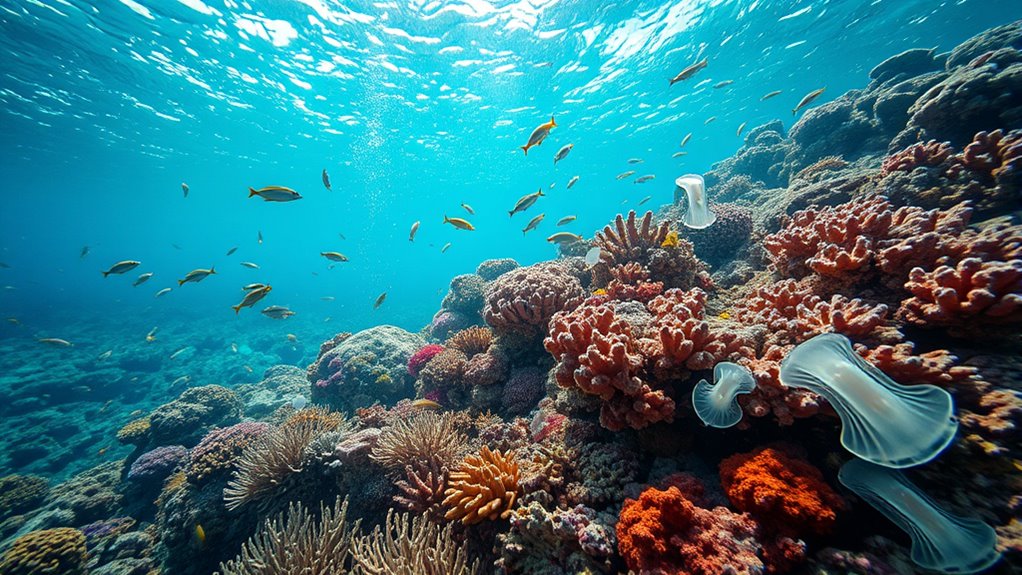

Ocean acidification, caused by excess CO₂ dissolving into seawater, drops the pH level and harms marine life. You’ll see marine organisms that rely on calcium carbonate, like corals and shells, struggle to build and maintain their structures, leading to weaker reefs and declining biodiversity. Over time, this disrupts entire ecosystems and food webs. Understanding these effects helps highlight the importance of reducing CO₂ emissions—stay tuned to discover more.
Listen free for 30 days with Audible
Thousands of audiobooks and originals — cancel anytime.
As an affiliate, we earn on qualifying purchases.
Key Takeaways
- Ocean acidification results from CO₂ absorption, lowering seawater pH and disrupting marine chemical balance.
- Acidic waters hinder calcium carbonate shell and skeleton formation in marine organisms like corals.
- Coral reefs weaken and dissolve, losing habitat for many marine species, leading to decreased biodiversity.
- Marine life adapts through pH regulation and habitat shifts, but these efforts are often insufficient.
- Ongoing acidification threatens ecosystem stability, food webs, and the health of global marine biodiversity.
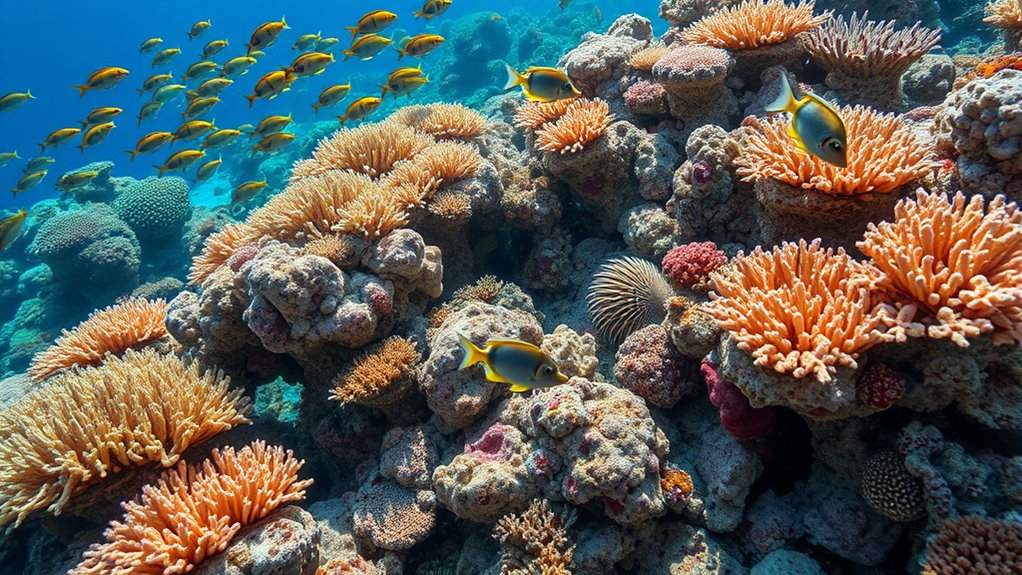
Ocean acidification occurs when the ocean absorbs excess carbon dioxide from the atmosphere, causing the water’s pH to drop. As CO₂ dissolves into seawater, it reacts with water molecules to form carbonic acid, which lowers the pH level. These pH level changes aren’t just numbers on a chart; they directly impact marine life, especially organisms that rely on calcium carbonate for their shells and skeletons. When the water becomes more acidic, it becomes harder for these creatures to maintain their structural integrity, threatening their survival. You might notice that as acidity increases, some marine organisms struggle to grow or reproduce, disrupting entire ecosystems.
In response to these pH level changes, marine organisms are forced to adapt in various ways. Some species may develop more efficient ways to regulate their internal pH or alter their shell-building processes. Others might shift their habitats to areas with more stable pH levels or evolve faster reproductive strategies to offset higher mortality rates. These adaptations aren’t always enough, and many species find themselves increasingly vulnerable. For instance, corals, which build their skeletons from calcium carbonate, suffer from dissolution as acidity rises. This hampers reef growth and weakens the overall structure, making reefs less resilient to storms and other environmental stressors.
Your understanding of marine organism adaptation is essential because it highlights the ongoing battle between life and the changing chemistry of the ocean. Some species may survive by modifying their biological processes, but these changes often come at a cost. Energy that could be used for growth or reproduction gets diverted to maintain homeostasis, leaving less energy for other critical functions. This shift can lead to decreased biodiversity, as only the most adaptable species endure. The interconnectedness of marine ecosystems means that as some organisms struggle or die out, the entire food chain feels the impact. Fish populations, for example, depend on healthy coral reefs for habitat and food sources; if reefs decline, so do the species that depend on them.
You should realize that these pH level changes aren’t just an immediate threat but a long-term challenge. Marine organism adaptation might allow some species to survive temporarily, but ongoing acidification could push many beyond their capacity to adapt. This ongoing process risks destabilizing marine ecosystems, potentially leading to loss of biodiversity, altered food webs, and diminished ocean health. Recognizing how pH fluctuations affect marine life emphasizes the importance of addressing CO₂ emissions and protecting the delicate balance of our oceans.
marine organism calcium carbonate shells
As an affiliate, we earn on qualifying purchases.
As an affiliate, we earn on qualifying purchases.
Frequently Asked Questions
How Quickly Is Ocean Acidification Progressing Worldwide?
You should know that ocean acidification is progressing rapidly worldwide, with global acidification rates increasing markedly over recent decades. However, regional variability influences how quickly local areas experience changes, depending on factors like CO2 emissions and water chemistry. This means some regions face faster acidification than others, making it urgent for you to stay informed and support efforts to reduce carbon emissions, which can slow down this alarming trend.
Are There Any Natural Processes That Counteract Acidification?
Natural buffering processes, like carbonate precipitation, help counteract ocean acidification to some extent. When seawater becomes more acidic, calcium carbonate minerals can form, which reduces acidity. You might not notice it daily, but these processes act as a natural buffer, stabilizing pH levels over time. However, they can’t fully offset the rapid acidification caused by human activities, so ongoing efforts to reduce CO2 emissions remain vital.
Which Marine Species Are Most Resilient to Acidification?
You’ll find that some marine species exhibit higher resilience to acidification due to their adaptive mechanisms. For example, certain mollusks and crustaceans can regulate their internal pH, helping them survive in more acidic waters. Some phytoplankton also adapt by shifting their photosynthesis processes. These species showcase greater resilience through flexible physiology and behavior, giving them a better chance to thrive despite increasing ocean acidity.
How Does Acidification Affect Deep-Sea Ecosystems?
You’ll notice that acidification impacts deep-sea ecosystems by altering abyssal chemistry, making it harder for organisms to maintain their internal balance. Many deep-sea creatures rely on unique adaptations for high-pressure, low-light environments, but acidification challenges these. You might observe changes in shell formation or metabolic processes, which threaten their survival. As a result, the delicate balance of deep-sea ecosystems could become destabilized, affecting biodiversity and ecological functions.
Can Artificial Methods Reverse Ocean Acidification?
Yes, artificial methods like marine alkalinity enhancement and artificial neutralization can help reverse ocean acidification. You can support these efforts by promoting research that increases seawater’s alkalinity, which buffers acidity. These techniques add substances like lime or crushed minerals to the ocean to neutralize excess carbon dioxide. While promising, you should also be aware that these methods are still experimental and require careful environmental assessments before large-scale deployment.
As an affiliate, we earn on qualifying purchases.
Conclusion
Imagine the ocean as a gentle giant, once thriving and vibrant, now slowly losing its breath. As acidification tightens its grip, marine life struggles to survive, and coral reefs fade like forgotten castles. You hold the key to turning this tide, but time is running out. If you act now, you can be the hero who restores the ocean’s song, ensuring future generations hear its beauty and marvel at its resilience.
ocean acidification educational models
As an affiliate, we earn on qualifying purchases.
As an affiliate, we earn on qualifying purchases.
marine ecosystem monitoring devices
As an affiliate, we earn on qualifying purchases.
As an affiliate, we earn on qualifying purchases.
Flea & tick season Picks
flea and tick prevention
As an affiliate, we earn on qualifying purchases.